Most villa gardens in Dubai fail for the same reason. Someone installs a lawn and a row of imported ornamentals, the irrigation bill climbs, and within two summers half of it has burned off. Desert landscaping in Dubai takes the opposite approach, since it works with sandy soil, salinity, and forty plus degree heat rather than fighting all three. Done properly, the result uses far less water, survives August without drama, and looks better than the imported alternative. Here is what actually goes into it.
What Desert Landscaping in Dubai Really Means
The term gets used loosely, so it helps to be precise. Desert landscaping, sometimes called xeriscaping, means designing a garden around plants and materials suited to an arid climate instead of importing a temperate garden and irrigating it into submission.
Importantly, this does not mean gravel and three cacti. Modern desert gardens in Dubai include shade trees, dense planting, seating areas, water features, and lighting. What changes is the plant palette, the irrigation design, and how seriously shade gets treated.
Start With the Soil, Not the Plants
This is the step most gardens skip, and it is why they underperform later. Dubai soil is typically sandy, low in organic matter, fast draining, and often saline. Water passes straight through it and nutrients go with it.
Consequently, a proper installation begins with soil testing and amendment. Organic matter improves water retention, gypsum can help with certain soil conditions, and salinity levels determine which plants are realistic in the first place. Skipping this stage means replacing plants repeatedly instead of once.
Ask your contractor this: did they test the soil, and what did the salinity reading say? A landscaper who cannot answer is guessing at your plant selection.
Choosing Plants That Actually Survive
Plant selection determines maintenance cost for the next decade, so it deserves more attention than it usually gets.
Reliable Choices for Dubai Gardens
- Ghaf: the UAE national tree, deeply rooted and genuinely drought tolerant, though slow growing
- Date palm: iconic and heat proof, but it needs real water and monitoring for red palm weevil
- Bougainvillea: heavy colour with modest water once established
- Desert rose and succulents: sculptural accents that tolerate neglect
- Native and adapted shrubs: the backbone that fills space without draining the irrigation budget
What Tends to Disappoint
Large lawns are the main culprit, since grass in Dubai consumes water continuously and still struggles through summer. Similarly, thin leaved imported ornamentals from temperate climates rarely last, and heavy fruiting trees demand more water and attention than most owners expect.
Worth knowing: the Ghaf is a protected species in the UAE. Removing or heavily pruning an established Ghaf on your plot generally requires permission, so check before any clearing work starts.
Irrigation and Water Use
Sprinklers lose a large share of their output to evaporation in Dubai conditions. Drip irrigation delivers water directly to the root zone instead, which is why it has become standard on well designed villa gardens.
Beyond the delivery method, three things matter. Zoning separates thirsty planting from drought tolerant areas so each gets what it needs. Smart controllers adjust to weather rather than running a fixed schedule. Mulch, meanwhile, is the cheapest improvement available, because a proper layer slows evaporation and moderates root temperature.
Greywater reuse and treated water connections are possible in some communities, although both are subject to authority and developer approval rather than being available by default.
Shade Is the Real Luxury
In this climate, an unshaded garden is decorative rather than usable. Shade turns square metres into living space.
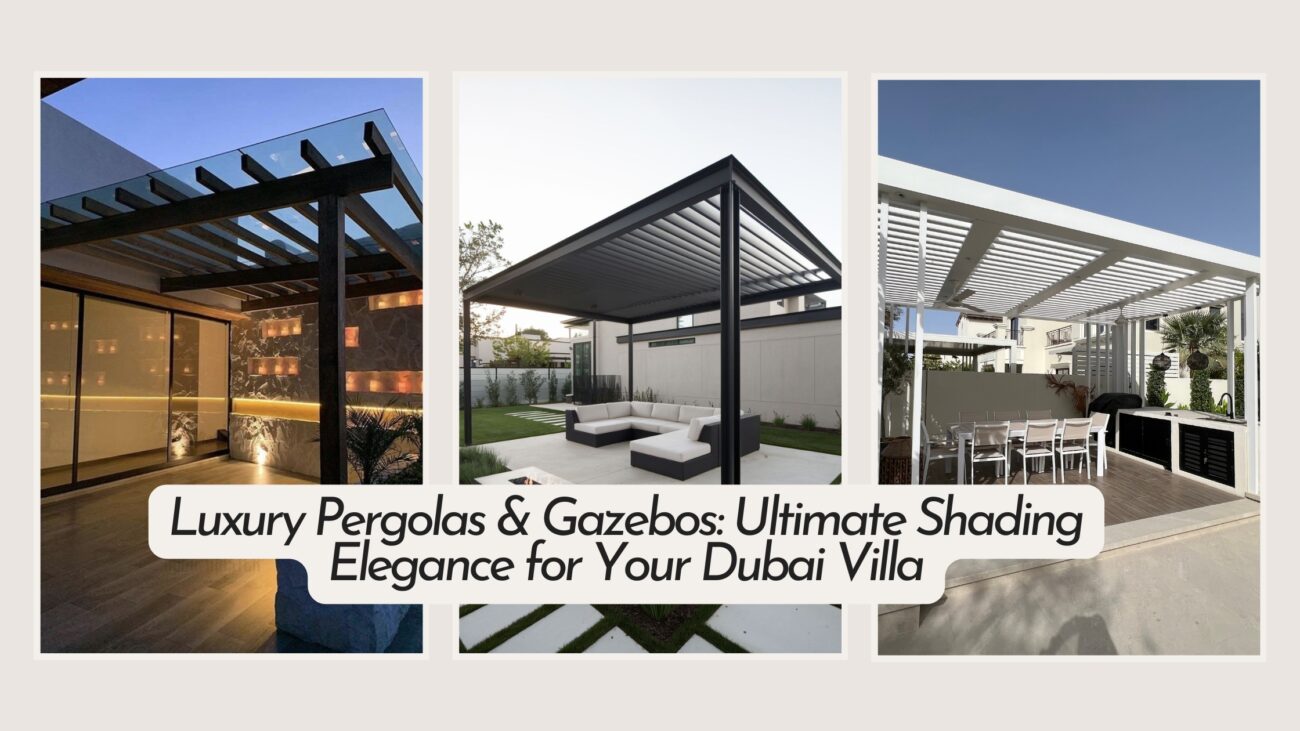
Trees deliver the best long term shade, yet they take years. Built structures work immediately, which is why most projects combine both. A pergola or shade structure over the main seating zone typically does more for daily usability than any planting decision.
Once shade exists, the area starts functioning properly. Pairing it with permanent outdoor seating and lounge areas and an outdoor kitchen or BBQ zone is what turns a garden into a room.
Hardscaping and Materials
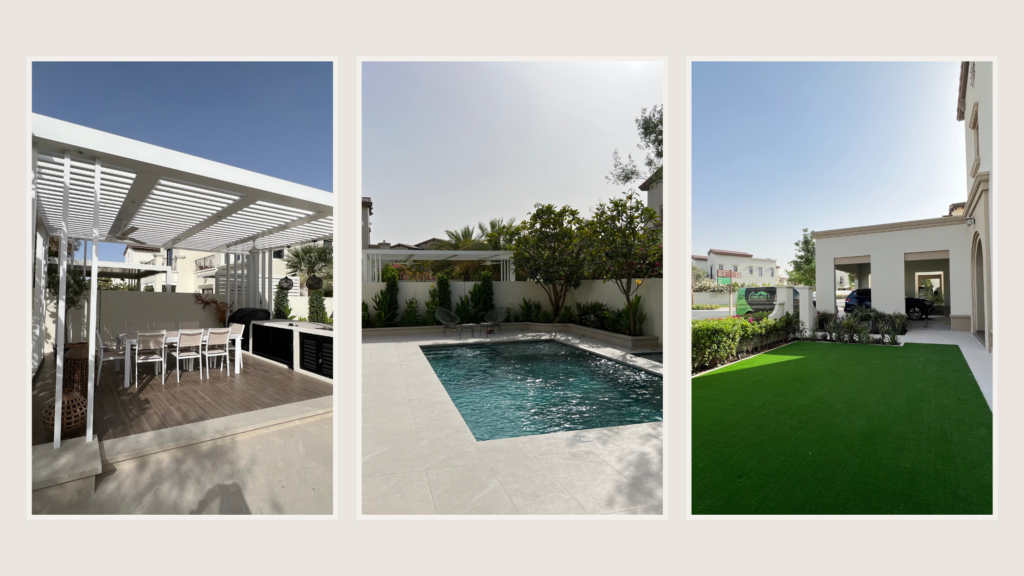
Surfaces matter more here than in cooler climates, mainly because dark materials become genuinely too hot to walk on barefoot.
| Material | Heat Behaviour | Best Used For |
|---|---|---|
| Light limestone or travertine | Stays comparatively cool | Pool surrounds, main terraces |
| Dark stone or dark porcelain | Gets very hot underfoot | Shaded areas only |
| Composite decking | Warm but manageable | Raised platforms, seating decks |
| Gravel and pebble | Cool and permeable | Planting beds, low traffic zones |
| Artificial grass | Heats significantly in sun | Shaded or small play areas |
Lighting After Dark
Dubai gardens get used in the evening for most of the year, so lighting is not decorative. It is what makes the space functional between October and April.
Layering works better than flooding. Low path lights for safety, uplighting on trees and textured walls for depth, and warm tones throughout rather than harsh white. Considered landscape lighting design and installation also avoids the common mistake of lighting the plot boundary and leaving the middle dark.
Water Features and Perceived Cooling
Moving water changes how a space feels, partly through evaporation and partly through sound masking traffic and AC noise.
Scale it sensibly, however, since oversized features in dry heat lose more water than owners anticipate. A compact, well filtered installation from a custom water feature design and build usually delivers the effect without the running cost of something larger.
Approvals and Community Rules
Landscaping is rarely as unregulated as owners assume. Boundary walls, pergolas, pools, and anything requiring foundations or electrical work generally need submissions.
Freehold communities frequently add their own design controls covering planting height, external finishes, and structures visible from the street. Our team handles the required approvals and community NOCs alongside the design, which prevents the situation where a finished pergola has to come down.
What Drives the Cost
Quotes for desert landscaping in Dubai vary enormously, so understanding the drivers is more useful than chasing a headline number.
- Plot size and how much of it is being developed
- Soil condition and how much replacement or amendment is needed
- Hardscaping area, since paving and structures usually dominate the budget
- Mature tree specimens, which cost far more than young stock
- Irrigation complexity and number of zones
- Pools, water features, and any structure needing foundations
- Lighting and electrical routing
- Site access, which matters on tight plots
Full garden projects generally run through our landscaping and outdoor design and contracting service, keeping design, hardscaping, planting, and irrigation on one programme.
The Maintenance Reality
Desert landscaping in Dubai reduces maintenance considerably. It does not eliminate it.
Irrigation emitters clog and need checking. Palms need periodic attention and weevil monitoring. Filters on water features require servicing, and planting needs seasonal pruning. Owners who prefer this handled on a schedule usually add the garden to an annual maintenance contract rather than arranging visits ad hoc.
Planning a Desert Garden for Your Villa
Send us your plot details and how you want to use the space. We will come back with a realistic design and scope.
Book a Free Site ConsultationFrequently Asked Questions
Can I remove a Ghaf tree from my property?
Not without checking first. The Ghaf is a protected species in the UAE, and removing or significantly pruning an established one normally requires authority permission. Confirm the position before any clearing begins, since penalties apply for unauthorised removal.
How much less water does a desert garden use than a lawn?
Considerably less, although the exact saving depends on plant selection, irrigation design, and how much lawn is replaced. The largest single reduction usually comes from removing or shrinking grass areas and switching from sprinklers to zoned drip irrigation.
Is artificial grass a good idea in Dubai?
It works well in shaded areas, small courtyards, and around play zones. In full sun it becomes noticeably hot underfoot during summer, so it suits partial use rather than covering an entire garden. Quality and infill also vary widely between products.
Do I need approval to landscape my villa garden?
For planting alone, usually not. Structures, pools, boundary changes, and electrical work generally do require submissions, and freehold communities often apply their own design controls on top. We confirm exactly what applies to your plot during the site survey.
When is the best time to install landscaping in Dubai?
Planting establishes best during the cooler months, broadly from October through April, because summer heat stresses new root systems. Hardscaping and construction can proceed year round, so many projects build in summer and plant in autumn.
How often does a desert garden need maintenance?
Most villa gardens do well on regular scheduled visits covering irrigation checks, pruning, and pest monitoring, with additional attention during seasonal changes. Frequency depends on planting density and whether pools or water features are included.